
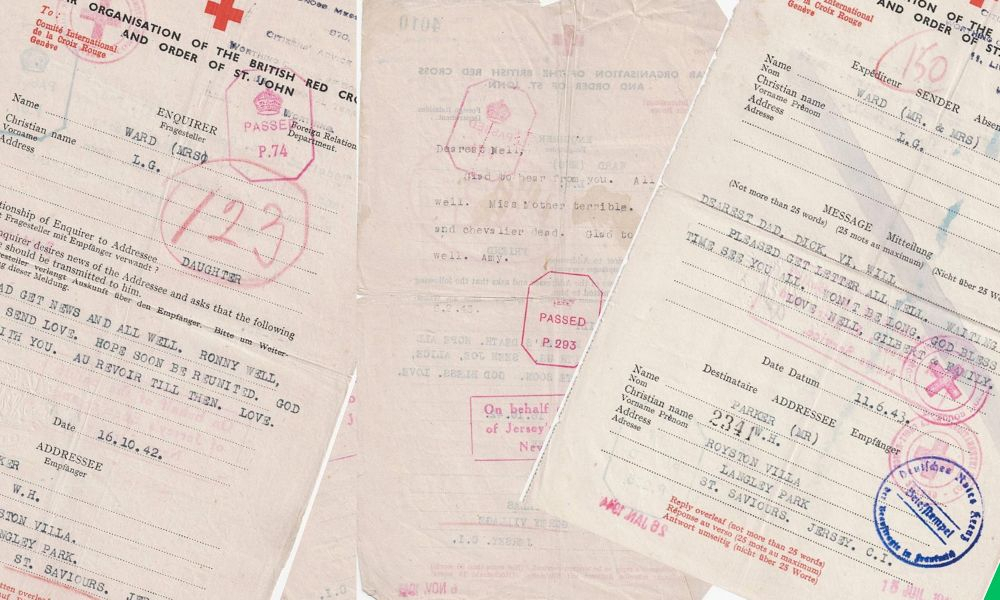
While I was going through some old family photos, I found these telegram-style messages that were sent between my grandmother in Selsey, West Sussex and her family in Jersey during the war. Nanny Ward, nee Ellen (Nell/Nelly) Parker, was originally from the island and it certainly seems like her Dad was there in WW2. We still have relatives living in Jersey and, thanks to Facebook, we’ve been able to connect with them. Coincidentally, one of my distant cousins, Justin, is a scooterist and we met for the first time at the Weymouth rally a couple of years ago!
[I’ve added a description of how the wartime messages worked, which is below the conversations and photos ⬇️]
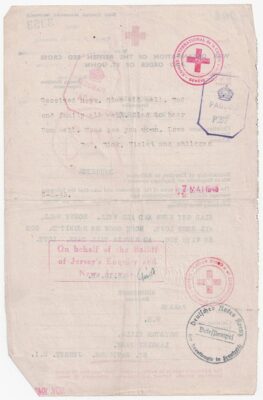
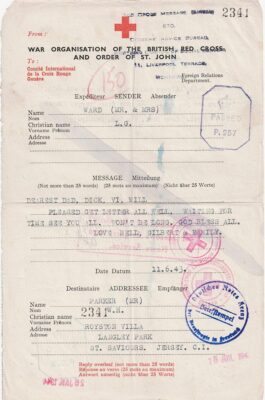
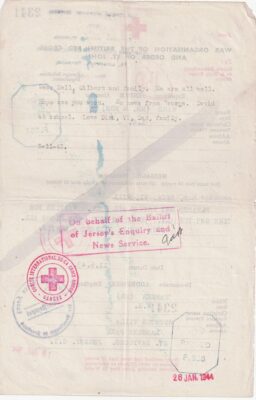
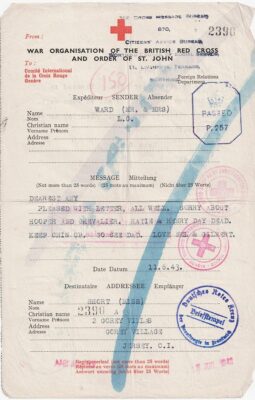
The messages to and from Jersey are fascinating and summarised below. It took months to get a reply, as they all went via Geneva, and include various stamps from the authorities to say that they have passed their censorship. I can only imagine how hard it must have been to wait for news of loved ones, knowing that Jersey was occupied by the Germans.
Each piece of paper contained the original message on one side, and then the recipient replied on the back. Words were limited to 25 less and luckily included a date so I’m able to reproduce them below, in chronological order.
Wartime messages to Jersey
25/9/1940 – To Mr WH Parker from Mrs LG Ward (Nanny)
This first one is confusing as it looks like Nanny didn’t write a message, there’s just a reply from Jersey, and although the main addressee is Mr WH Parker, the reply seems to come from Mr R Parker, who is presumably ‘Dick’.
We are all well. Dad is glad to here (sic) you are well. Also George and family are evacuated. Love from all. Dick, Dad and Family.
12/11/1940 – To Mr WH Parker from Mrs LG Ward (Nanny)
Dearest Dad, are you alright? Thinking of you. Love Nell
Reply sent 13/2/1941:
Dear Nell, all well at present. Hope you are all the same. Keep smiling. Love from all.
12/11/1940 – To Miss Amy Short from Mrs Nell Ward
Dearest Amy, are you alright? Please answer. Love Nell
Reply sent 14/2/1941:
I and all are quite well. Glad to hear from you. Mother fairly well. Hope children are well. God bless you all. Love from all. Amy Short.
14/4/1942 – To Mr WH Parker from Mrs LG Ward
Dearest all. Hope you well. Longing for news. Looking forward happier days. God bless and keep you all well, safe. Love Nell, Gilbert, Lance, Denny.
Reply sent 15/6/1942:
Dear Nell, Gilbert, Lance, Denny. We are all well here. Glad to have news. Have sent two before. How is Ronny Wells. Love from all.
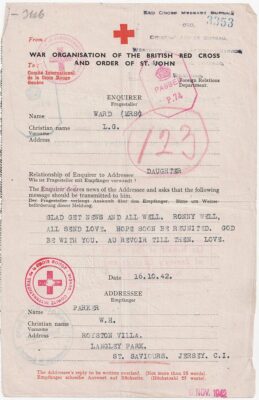
16/10/1942 – To Mr WH Parker from Mrs LG Ward
Glad get news and all well. Ronny well. All send love. Hope soon be reunited. God be with you. Au revoir till then. Love.
Reply sent 6/2/1943:
Received news. Glad all well. Dad and family all well. Glad to hear Ron well. Hope see you soon. Love Dad, Dick, Violet and children.
16/10/1942 – To Miss Amy Short from Mrs Nell Ward
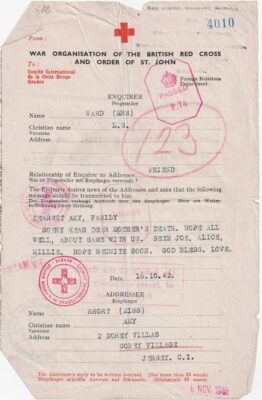
Dearest Amy, Family. Sorry hear dear mother’s death. Hope all well, about same with us. Seen Joe, Alice, Millie. Hope reunite soon. God Bless. Love.
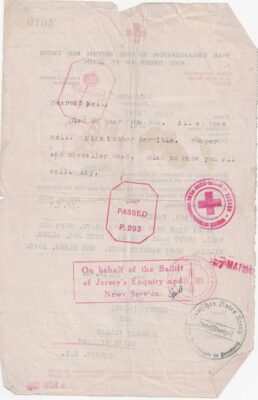
Reply sent 6/2/1943:
Dearest Nell. Glad to hear from you. All at home well. Miss Mother terrible. Hooper and Chevalier dead. Glad to know you all well. Amy.
11/6/1943 – To Mr WH Parker from Mr & Mrs LG Ward
Dearest Dad, Dick, Vi, Will. Pleased get letter all well. Waiting for time see you all. Won’t be long. God bless all. Love Nell, Gilbert & family.
Reply sent 5/11/1943:
Dear Nell, Gilbert and Family. We are all well. Hope see you soon. No news from George. David at school. Love Dick, Vi, Dad, family.
11/6/1943 – To Miss Amy Short from Mr & Mrs LG Ward
Dearest Amy. Pleased with letter, all well. Sorry about Hooper and Chevalier. Katie and Henry Day dead. Keep chin up. Go see Dad. Love Nell & Gilbert.
Reply sent 9/11/1943:
Nell and Gilbert, Received your news. Pleased to know you both well. All at home well. Hope will see Dad soon. Longing to see you both. Love Amy.
16/11/1943 – To WH Parker from Mrs LG Ward
Dearest Dad and All. Happy new year. Soon with you. Keep well and chin up. Write again. All well and send love. God be with you. Love Nell & Gilbert.
Reply sent 7/3/1944:
Dear Nell and Gilbert. Glad to hear all well. Up to now, we are. Hope to see you soon. Love Dad, Dick, Vi, children.
My feelings
I find these messages so poignant. In today’s world where everything is sent and received instantly, it seems unimaginable to wait for months to hear whether your loved ones are safe and sound. I’m grateful my grandparents, Dad and uncle were in the relative safety of West Sussex. I wish my Dad was still around to ask about his recollections again. We must all write more down, because otherwise these memories are lost. That’s one of the reasons I love having a blog as it’s somewhere I can share my thoughts and photos, for myself as much as anyone else as my memory is terrible.
Here are the messages which I scanned, and you’ll see on some of them some blue marks, which is the Germans trying to test if there were any hidden messages on the paper. Below the photo gallery is an explanation of how the telegrams were sent via the Red Cross, which I find absolutely fascinating.
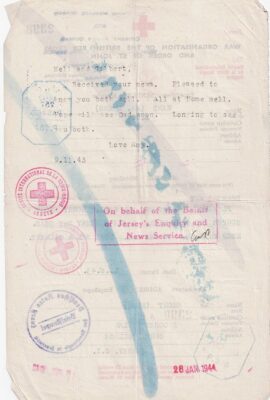
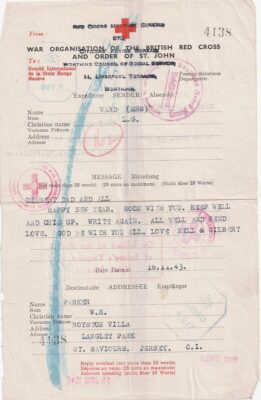
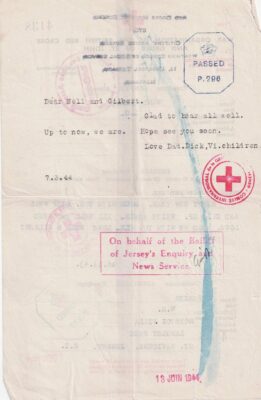
Mail to and from Jersey during WW2
This explanation was sourced from ephemeraltreasures.net :
The British Red Cross Society set up a new department, the Civilian Message Section, in the autumn of 1939, soon after Germany attacked and occupied Poland. By December, 1940, a well-organised message service was in existence in both the United Kingdom and Germany, allowing British nationals who had been interned in Nazi-occupied countries to communicate with their families.
Messaging Rules
Messages had to be posted or handed in to a Red Cross Message bureau and could only be sent to a relative, fiancé, or fiancée (later, friends were included). They had to be inscribed in block letters or typed on blank copies of a special form and carbon copies had to be made.
Initially only British citizens were allowed to interpret, inscribe, and handle messages but by the end of 1940, the message scheme had been streamlined. People enquiring about their families and friends could purchase copies of Form 61 for a shilling each to complete on their own, then post them to or drop them off at a Red Cross Message Bureau in cities across the U.K. The Red Cross would in turn post bundles of 10 messages to the I.C.R.C. in Geneva, where they would be placed in purpose-designed envelopes and forwarded to the appropriate authorities.
The forms were designed to carry a message to the recipient, who in turn would reply on the same form. The return address was not included (the Red Cross maintained records of each message, including the addresses, which were used to post responses to the original senders). Both the British Red Cross and the German Red Cross (Deutsches Rot Kreuz) produced their own Form 61s. Interestingly, the British forms were printed in English, German, and French, but the German forms were only printed in German and French.
Like virtually all international mail during the Second World War, most Red Cross messages were subject to censorship in both England and Germany, on their way to and from their destinations. As well as looking at the hand-printed or typewritten texts, the Germans often brushed a chemical on the paper to reveal “invisible” messages; the chemical left blue streaks behind. Most forms include multiple handstamp impressions indicating that the contents had been censored, as well as ones indicating which Red Cross bureaux transmitted the messages and received them.
Snail Mail
The message scheme was extremely slow, because they were sent via London to a British port, probably Weymouth and then by boat to Lisbon (as Portugal was neutral). They then went to Marseilles and then Geneva. From there they went to the German Red Cross, either in Berlin or France. Once they had passed the censorship, they were sent through France to the Channel Islands.
Replies to messages or messages originating in the Channel Islands travelled the same route, but in reverse, and were also censored by Germany and England.
